Deux étudiants se démarquent dans le cadre des prestigieux « 2025 Drawing of the Year Awards » organisés par Archisource
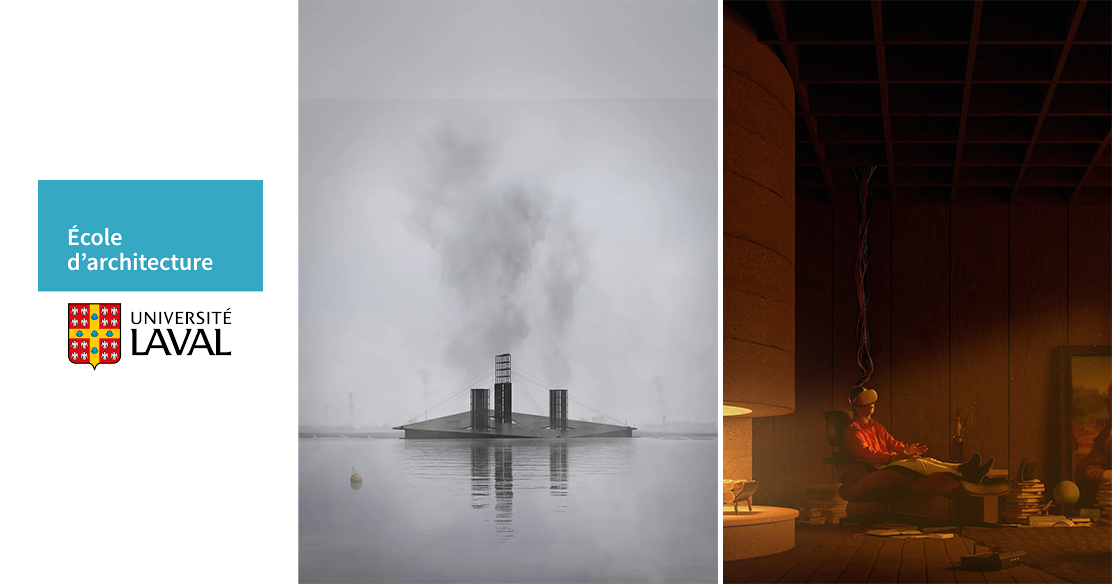
De la part de l’ÉAUL :
« Deux étudiants de l’École d’architecture de l’Université Laval se sont démarqués parmi plus de 7 000 candidatures reçues dans le cadre des prestigieux 2025 Drawing of the Year Awards organisés par Archisource.
- Thomas Biscaro est lauréat du 2025 Beyond Visualisation Award ainsi que d’une mention spéciale dans la catégorie 2025 Visualisation Award
- Charles-Antoine Lauzon obtient une mention d’honneur dans la la catégorie 2025 Beyond Visualisation Award
Le jury, composé d’experts issus de firmes renommées telles que Foster + Partners, Zaha Hadid Architects et RSHP, a souligné l’originalité et la qualité exceptionnelle des propositions récompensées.
Félicitations à nos lauréats pour ces distinctions remarquables qui témoignent du talent et de la créativité de notre relève en architecture !
Pour en savoir plus sur les projets lauréats du concours…
Pour consulter le projet complet de Thomas Biscaro, finissant de la maitrise professionnelle 2025…
Dystopia of the Omnicidal Landscape par Thomas Biscaro
« Near the China–Mongolia border, the city of Baotou silently reshapes our reality by extracting nearly half of the world’s rare earth metals—key to the devices that embody our belief in inevitable progress. Ten kilometers away, a toxic lake swells with radioactive waste. Nothing lives there. This project explores speculative architecture as a catalyst for awareness, staging a doomed decontamination plant at its center. The worker returns daily, repeating futile gestures as the lake rises. Architecture becomes a witness—an anti-memorial—making visible what we strive to forget: our denial, our inertia, our collapse. »
The [Ordinary Man] par Charles-Antoine Lauzon
« Natural light is often perceived as a resource capable of creating infinite atmospheres. However, it is too often taken for granted and seen as eternal. The project seeks to reexamine the use of direct natural sunlight in architecture by exploring the consequences of humanity’s relentless pursuit of « constant evolution ». The House of Anthology becomes a satirical apology of our conditions of existence in a world where direct light has been replaced by a diffuse luminosity, scattered by an infinite number of suspended particles in the atmosphere. The man embodies [the ordinary man], the path that has led to the current state. He is the sole master on board but does nothing to improve the situation. »