EN VITRINE DE MARS | Idées canoniques dans les domaines du design et de l’architecture
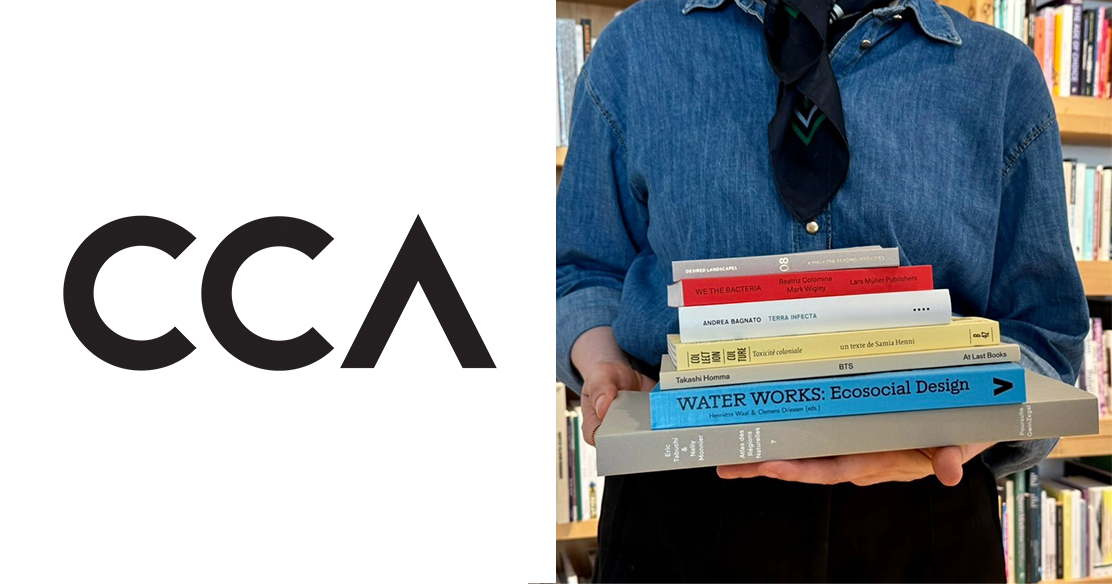
De la part de la librairie du Centre Canadien d’Architecture :
« Ce mois-ci, notre sélection de livres présente des groupes de recherche qui réfléchissent aux idées canoniques dans les domaines du design et de l’architecture. À travers des cadres interdisciplinaires et des conversations informelles, ils remettent en question les idées préétablies, mettant en évidence les tensions existantes dans les modes de connaissance.
- Le mercredi, même si le musée est fermé, la librairie peut ouvrir sur rendez-vous. Nous vous invitons à venir bouquiner, lire, et demander quelques conseils.
- Contactez-nous par courriel ou téléphone : livres@cca.qc.ca ou 514-939-7028
We the bacteria : Notes towards biotic architecture
Beatriz Colomina & Mark Wigley. Lars Müller, 2026
The sequel to the authors’ Are We Human?, this provocative book is an urgent manifesto for an alternative architectural philosophy. It treats bacteria as the real architects, construction workers, maintenance crews and inhabitants of buildings. Colomina and Wigley draw on the latest research into microbes to rethink the past and possible futures of the built environment. The book explores the intimate entanglements of the microbes within bodies and buildings over the last 10,000 years, culminating in the antibiotic philosophy of contemporary architecture.
Toxicité Coloniale : Documenter le paysage radioactif dans le Sahara
Samia Henni. Éditions B42, 2026
Toxicité coloniale revient sur les programmes nucléaires français menés entre 1960 et 1966 dans le Sahara algérien. Ce programme secret, qui s’est déroulé pendant et après la guerre d’indépendance algérienne (1954-1962), a permis au régime colonial français de mettre à feu quatre bombes atomiques atmosphériques, treize souterraines et de mener d’autres expériences nucléaires dans le désert. Alors que la grande majorité des documents d’archives sont toujours classés secret aujourd’hui, Toxicité coloniale rassemble une variété de sources permettant de documenter l’histoire violente des activités de la France en Algérie. Le livre constitue un corpus de choix à l’intersection de la justice spatiale, sociale et environnementale pour ceux et celles qui s’intéressent à l’architecture, au paysage et aux pratiques d’archivage dans une démarche décoloniale.
Terra Infecta
Andrea Bagnato. MACK, 2026
In Terra Infecta, Andrea Bagnato tells an unfamiliar story about a well-known place. Since the early days of tourism, the cities and landscapes of Italy have been bywords for beauty and grandeur. But, at home and abroad, the same places have also been haunted by associations with disease and uncleanliness, often more to do with politics than conditions on the ground. Bagnato shows how the modern quest for sanitation shaped Italy’s urban and rural landscapes, propelling major transformations from the draining of the wetlands around Venice, to demolitions and replanning in Naples, to the expulsion of the inhabitants of ancient Matera.
ARN Vol.7 : Atlas des régions naturelles
Eric Tabuchi, Nelly Monnier. Poursuite Éditions, 2025
Avec ce septième volet de l’Atlas des Régions Naturelles, Eric Tabuchi et Nelly Monnier poursuivent leur projet au long cours engagé en 2017 : la documentation globale des 450 régions naturelles – ou « pays » – qui composent le territoire français. Une aventure photographique hors normes destinée à se déployer sur plusieurs années, au rythme d’une publication par semestre.
Water Works : Eco-social design
Henriëtte Waal & Clemens Driessen. Valiz, 2025
Through a collection of essays and case studies, Water Works shows over sixty careful responses to flooding, draught, pollution, extraction and other issues around freshwater. Divided into seven themes: Purity, Wild, Scale, Representation, Violence, Infrastructure and Commerce, Water Works allows us to learn from places and makers that build on the intricate relationships between people and other life forms, materials and (infra)structures.
Takashi Homma: BTS, Behind the Scenes
At Last Books, 2026
In BTS, Takashi Homma turns his lens toward the unnoticed rituals of protection and concealment that shape everyday life. Shot primarily in Tokyo – with detours to Colombia, Hawaii, and beyond – the book gathers images of covered cars, wrapped trees, shuttered windows, snow-draped landscapes, and figures layered in clothing until their faces disappear. What emerges is a quiet study of surfaces, shields, and the spaces between what is shown and what is hidden. BTS reveals a world perpetually preparing, preserving, or holding something back – an unseen choreography unfolding just behind the scenes.
Desired Landscapes, Issue 8
A magazine reading into cities, 2025
We walk in cities with no postcards, only to collect postcards from home. We close our eyes to move our bodies through dense tourism and rising floods. We drive through the past, holding on to occult rituals to stay rooted. We taste the city on the go, misled by its disguised façades and concealed staircases. We bring home wild plants, only to forget them, and choose to live beside volcanoes despite the risk. We switch off the lights to walk under the stars, and to hear the echoes of suppressed rivers. In this issue, we sense all kinds of flows.
Colonial Toxicity: Rehearsing French radioactive architecture and landscape in the Sahara
Samia Henni. Framer Framed, 2023
In the 1960s the French colonial regime detonated four atmospheric atomic bombs, thirteen underground nuclear bombs, and conducted other nuclear experiments in the Algerian Sahara. This secret, still-classified programme occurred during and after the Algerian War (1954–1962). Meticulously culled together from numerous sources by architectural historian Samia Henni, this publication’s wealth of materials documenting the violent history of France’s activities in the Algerian desert offers a rich repository for all those concerned with histories of nuclear weapons and engaged at the intersections of spatial, social, and environmental justice, as well as anticolonial archival practices.